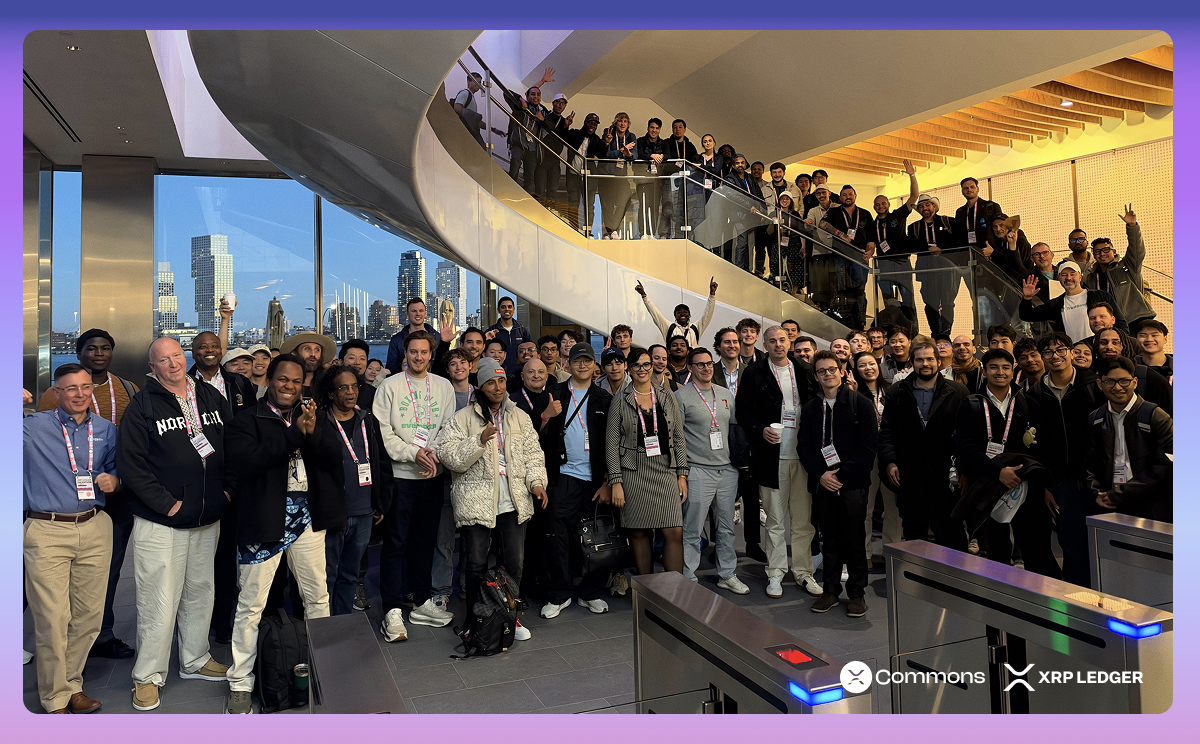
The 2026 AI & Fintech XRP Ledger Hackathon in New York was the most ambitious XRPL hackathon yet, bringing together the strongest lineup of partners and industry experts we have assembled. Hosted by XRPL Commons, the hackathon set out to extend the ledger's infrastructure with the environments, tools, assets and expertise of Ripple, the XRP Ledger Foundation, Mastercard, Ledger, AWS and Quicknode.
Together, we brought the XRP Ledger's core primitives and our partners' capabilities into one place, giving builders the assets and infrastructure to design new applications on the XRPL.
The timing mattered. The hackathon took place the weekend before the annual Swell conference hosted by Ripple, just as x402 payments on the XRP Ledger passed 10 million transactions and native lending entered validator voting.
The work ran across four tracks:
- Agentic Finance: agents that hold, move and settle value on the XRPL, including agent-to-machine payments where agents pay for data, APIs and services within set limits.
- Lending & Borrowing: credit and yield strategies built on the ledger's native lending and vault features (currently in voting).
- Protocol Innovation: projects that build on, extend or improve the XRPL's native functionality.
- Why Not: an open track for ideas that fall outside the other three.
The largest group of teams took on the agentic finance question: when an AI agent needs to spend money, who authorizes the payment, who sets the limits, and who is accountable when something goes wrong? Others built ahead of mainnet on vaults and the Lending Protocol.
A sandbox for the latest tech in finance
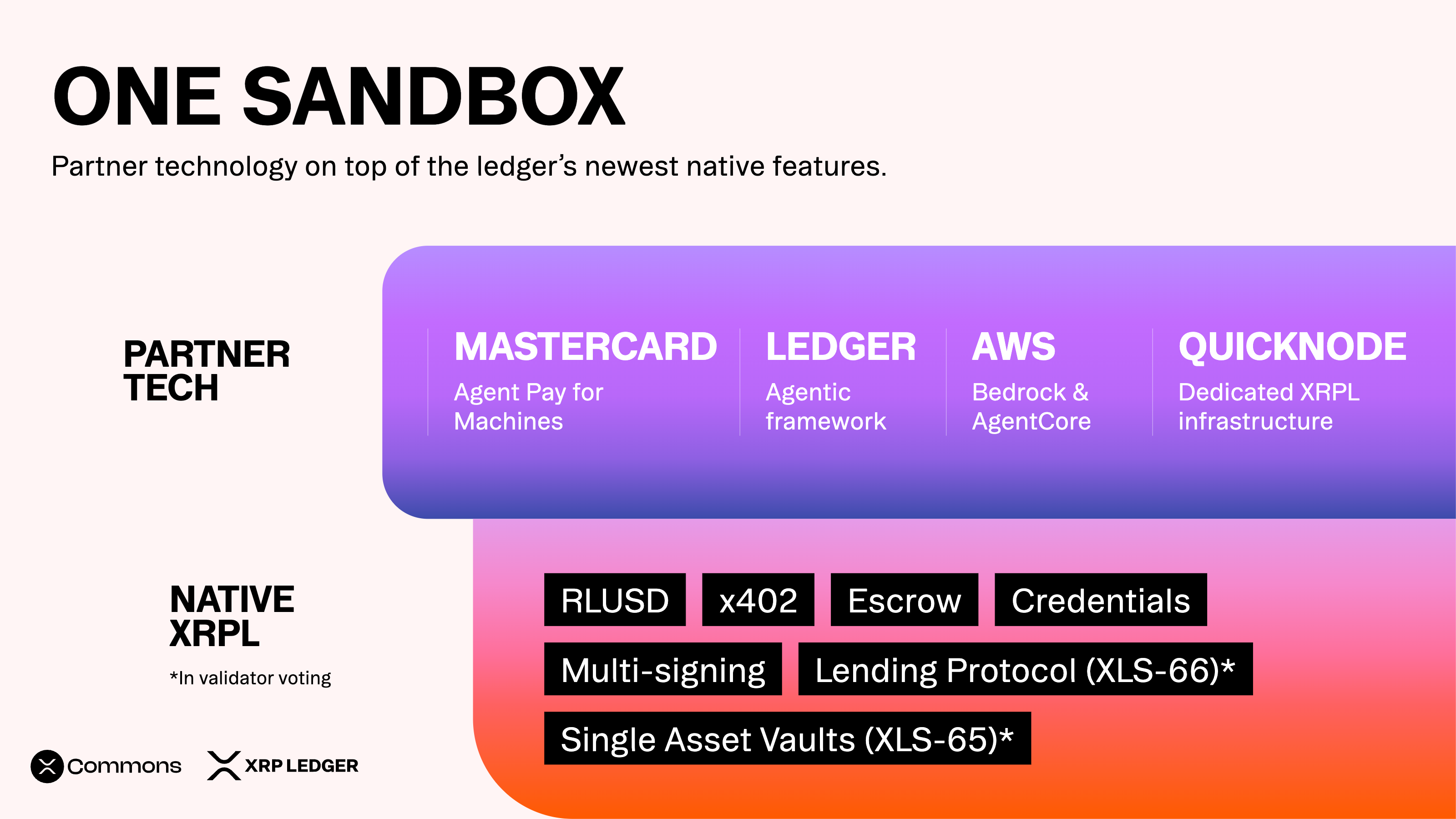
Builders could combine partner technology with the ledger's newest native features, with partner teams on hand to help. Among the technology available to them:
- Mastercard Agent Pay for Machines: a multi-rail payment service launched by Mastercard in June 2026 that enables AI agents to make secure, permissioned machine-to-machine and continuous background payments without human intervention at every step.
- Ledger Agentic framework: an architecture in which autonomous AI agents propose transactions, but a human must physically approve them on a secure Ledger screen before execution.
- AWS Bedrock and AgentCore: Amazon Bedrock provides access to leading foundation models, while AgentCore provides the infrastructure to deploy and operate AI agents securely at scale.
- Quicknode: dedicated XRPL infrastructure, including high-performance endpoints and real-time data streams for reading ledger state and confirming transactions.
- Native XRPL building blocks: RLUSD and x402 for agent payments, escrow, credentials and multi-signing, plus the Lending Protocol (XLS-66) and Single Asset Vaults (XLS-65), currently in validator voting.
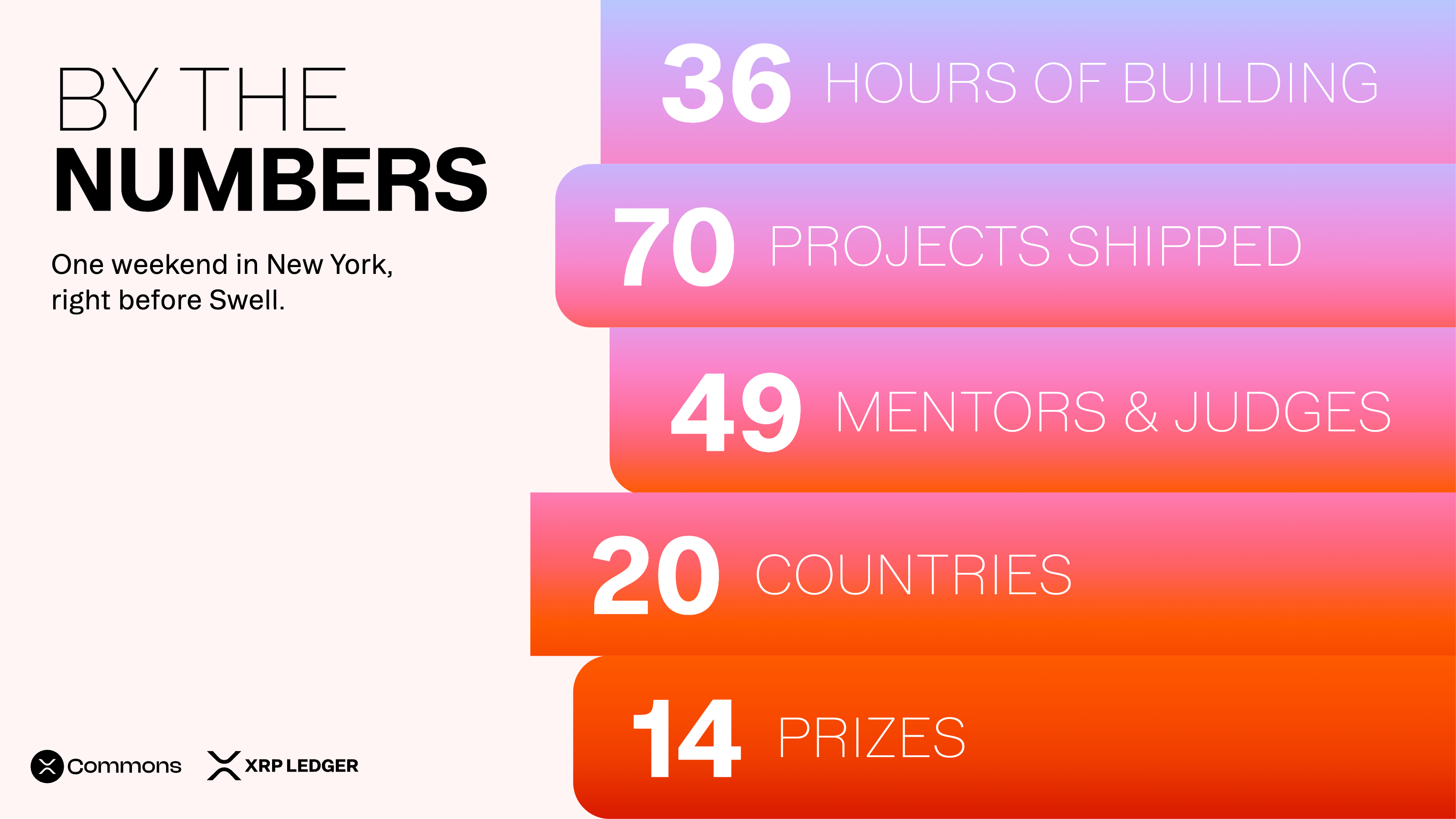
49 mentors and judges supported the teams. Participants, mentors, judges, and partners came away impressed by the venue, the execution, and the level of expertise in the room. Engineers from Ripple, Mastercard, AWS, Ledger, Quicknode, T54, Soil, Common Prefix, Evernorth, XRPScan, BSA-EPFL, AI Hedge Finance, Blockvault, Mertia, Nextrope, EBS-NYU, Exfil, Ochoa de Olza Capital Partners, Columbia, the XRP Ledger Foundation, XRPL Commons, and more were on hand, so questions were answered in minutes.
Who came to build
The room mixed three groups in close to equal parts. About a third were students, many arriving with their university blockchain clubs from schools such as Cornell, NYU, Penn, the University of Kansas and the National University of Singapore. Another third were founders building companies, and a fifth were working developers, joined by academics, product managers and designers. Seven in ten brought developer skills, and a third rated themselves advanced. More than half had never built on the XRP Ledger before the weekend. Most were based in the US, with builders from 20 countries in all, including Singapore, South Korea, France, Australia, Germany, the UK and Canada.
The hackathon was open both to new ideas and to projects already underway. Builders could start from scratch, or bring an existing project or startup, on XRPL or elsewhere, and use the 36 hours to add XRPL rails or ship a new feature; only what was built during the hackathon counted toward judging. Both paths were well used: more than four in ten participants planned to start from scratch, while one in five brought a project they were already building, many of them founders using the weekend as a focused sprint with mentors on hand.
What got built
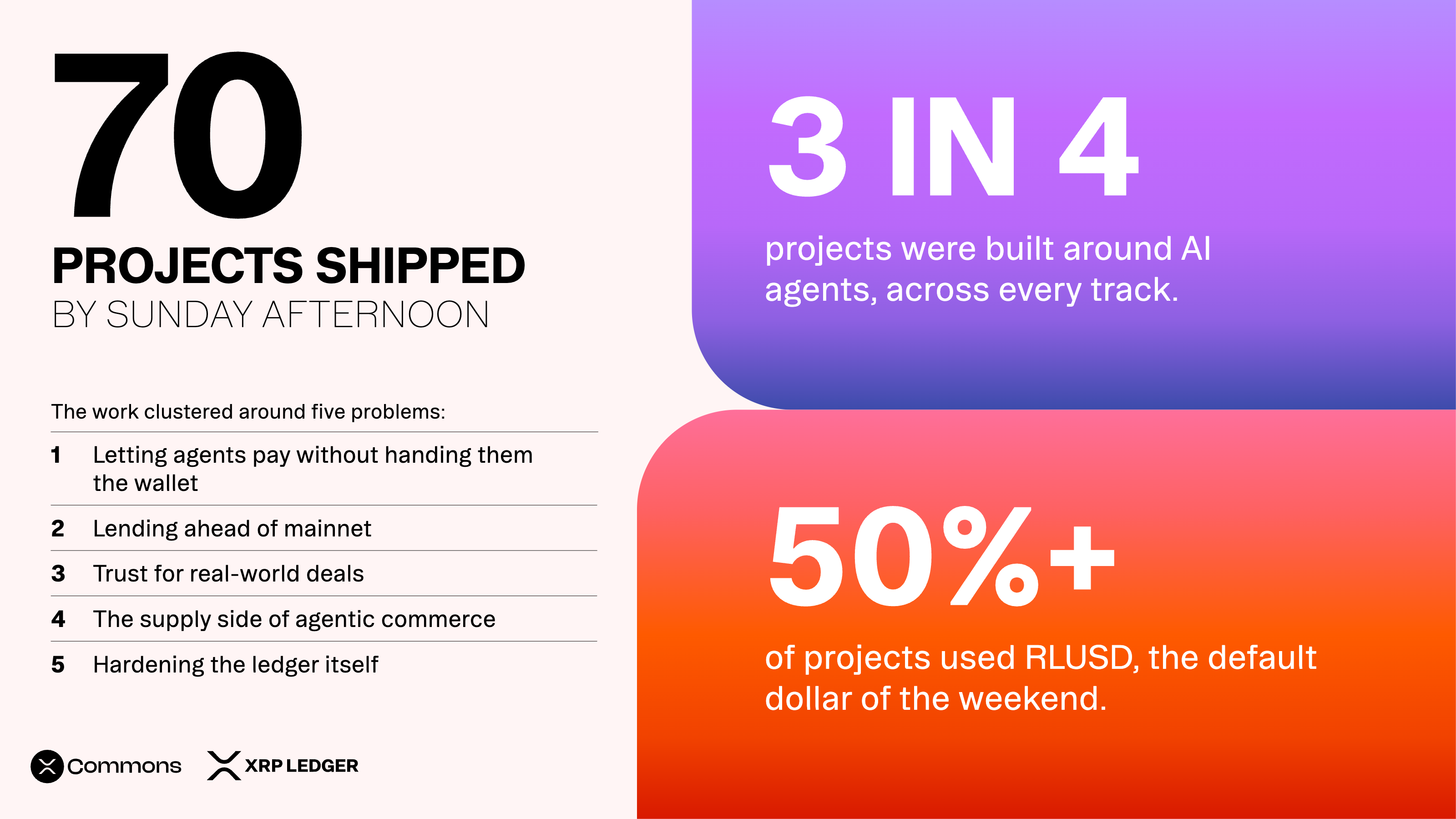
By Sunday afternoon, 70 projects had shipped. Agents were the common thread: three in four projects were built around them, including many outside the Agentic Finance track. Every project is on the hackathon projects page. The work clustered around five problems:
- Letting agents pay without handing them the wallet: spending limits, approval on a Ledger device for larger payments, and "Know Your Agent" checks. One team's agent bought everything a new store needed over x402, then launched it.
- Lending ahead of mainnet: binding loans, construction loans released stage by stage from escrow, and short-term credit from lending vaults, all built before the Lending Protocol goes live.
- Trust for real-world deals: escrow for payroll, hospitality accounts and critical-minerals trades, and tokenized assets from gold to farmland.
- The supply side of agentic commerce: stores that agents can read and buy from, and supplier agents that negotiate wholesale orders.
- Hardening the ledger itself: human-readable signing, post-quantum signature benchmarks, formal proofs and privacy with compliance built in.
RLUSD was the default dollar of the weekend, appearing in more than half of all projects as the currency agents pay in, the asset held in escrow and the dollar loans are denominated in.
The winners
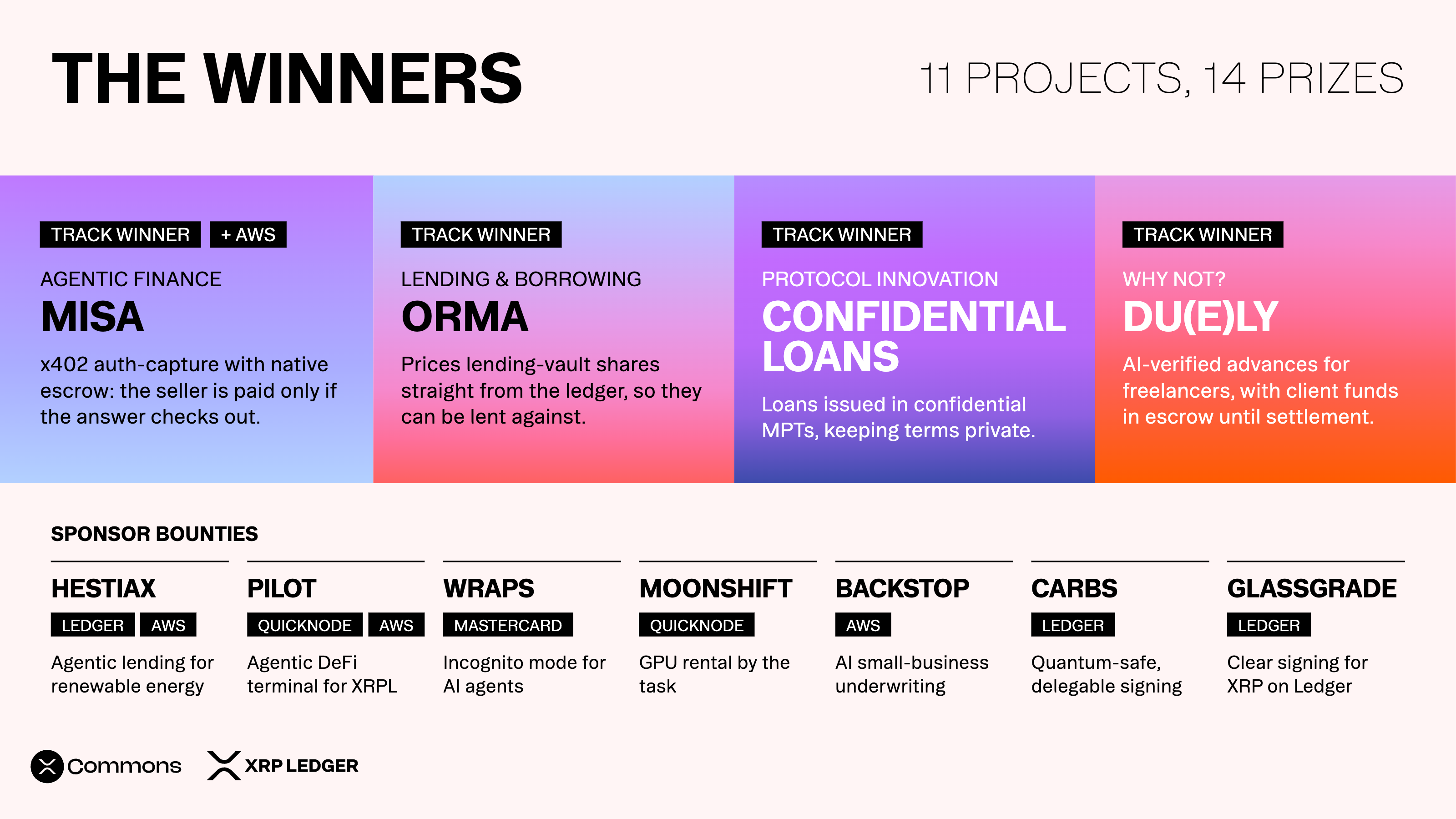
Eleven projects took home 14 prizes: a winner in each track and ten sponsor bounties.
Agentic Finance
- Misa (track winner and AWS bounty): open-source x402 auth-capture for XRPL. An agent locks XRP in native escrow, and the seller is paid only if the answer checks out. Demoed with an AWS AgentCore agent.
- Wraps (Mastercard bounty): incognito mode for AI agents, keeping their tool calls, browsing and payments private, with pay-per-use pricing.
- HestiaX (Ledger bounty): agentic lending for small and mid-sized renewable energy projects, with AI agents managing loans within a mandate humans sign on their Ledger device.
- Pilot (Quicknode bounty): the agentic DeFi terminal for XRPL, bringing every XRPL venue into one AI workspace.
- MoonShift (Quicknode bounty): GPU rental by the task, where GPU owners can borrow against their shares from a native XRPL vault.
Lending & Borrowing
- Orma (track winner): prices XRPL lending-vault shares directly from the ledger, so they can be lent against with a report a risk committee can sign off on.
- Backstop (AWS bounty): private credit made accessible, with AI small-business underwriting and investor-selected risk tranches.
Protocol Innovation
- Confidential Loans (track winner): a protocol amendment that lets loans be issued in confidential MPTs, keeping loan terms private between broker and borrower.
- CARBS (Ledger bounty): quantum-safe, delegable signing for XRPL, with ledger-enforced signing sessions and an ML-DSA-44 key on a Ledger Stax.
- HestiaX (AWS bounty), its second prize of the weekend.
Why Not
- Du(e)ly (track winner): helping freelancers get paid sooner with AI-verified advances, while client funds stay in escrow until settlement.
- GlassGrade (Ledger bounty): clear signing for XRP on Ledger, with a plain-language reputation score for the destination wallet before you sign.
- Pilot (AWS bounty), its second prize of the weekend.
From bootcamp to hackathon, and beyond

For many builders, the hackathon was one step on a longer path. The three-day Core Dev Bootcamp, held October 20–22 just before the hackathon, was the perfect way into the Protocol Innovation track. Participants went deep on the XRPL's protocol internals, then carried what they learned straight into the build sprint. Two bootcamp teams went on to win prizes: CARBS took the Ledger bounty in Protocol Innovation with quantum-safe, delegable signing, and HestiaX left New York with two bounties. The bootcamp also built more than code. One participant was recruited by another after they met during the week. That's the network effect at its best.
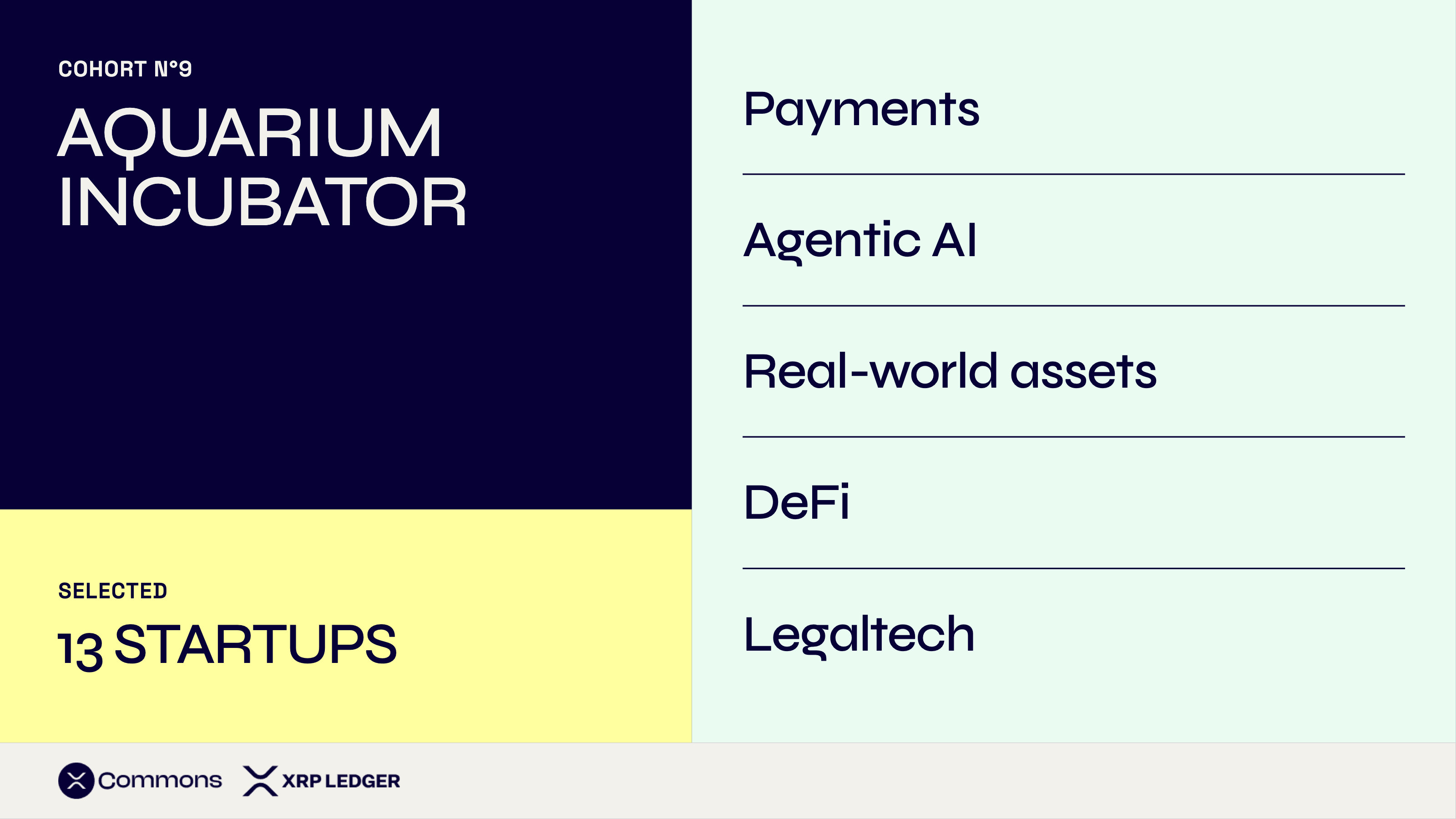
The weekend showed the rest of the XRPL Commons builder pipeline at work too. Many teams from the Aquarium, our startup incubator, attended, using the hackathon to start new projects or sprint on new features. Past participants of Make Waves, our 90-day online buildathon, were on the winning teams, including the Zeno team behind Confidential Loans, winner of the Protocol Innovation track.
That path continues well after the prizes are handed out. herVoice, a winner of our Paris hackathon earlier this year, has since become FTCare, is building its company and has joined the UDAX accelerator program. Bootcamp, buildathon, hackathon, incubator: each step is a way in, and builders can join at any of them.
What comes next
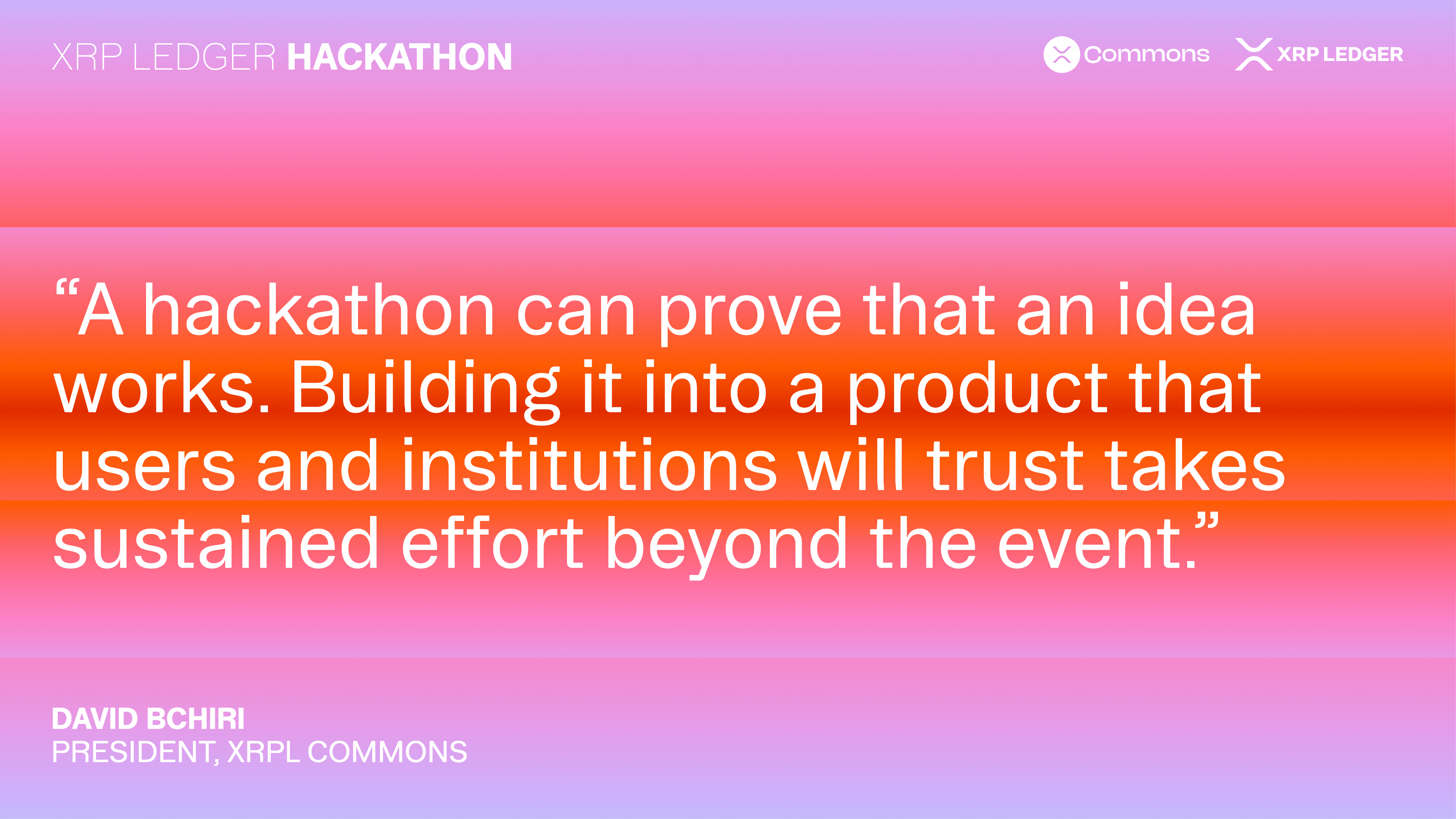
"A hackathon can prove that an idea works," said David Bchiri, President at XRPL Commons. "Building it into a product that users and institutions will trust takes sustained effort beyond the event."
That work starts now. XRPL Commons will keep working with the strongest teams through technical mentorship, partner introductions, grant fast-tracking and the Aquarium startup program. Partners and investors interested in any of the 70 projects can reach out, and we will make the introduction.
Thank you to our partners Ripple, AWS, Mastercard, Ledger and Quicknode, to the XRP Ledger Foundation, to every mentor and judge, and to every builder who spent their weekend shipping on XRPL.
Explore the hackathon