


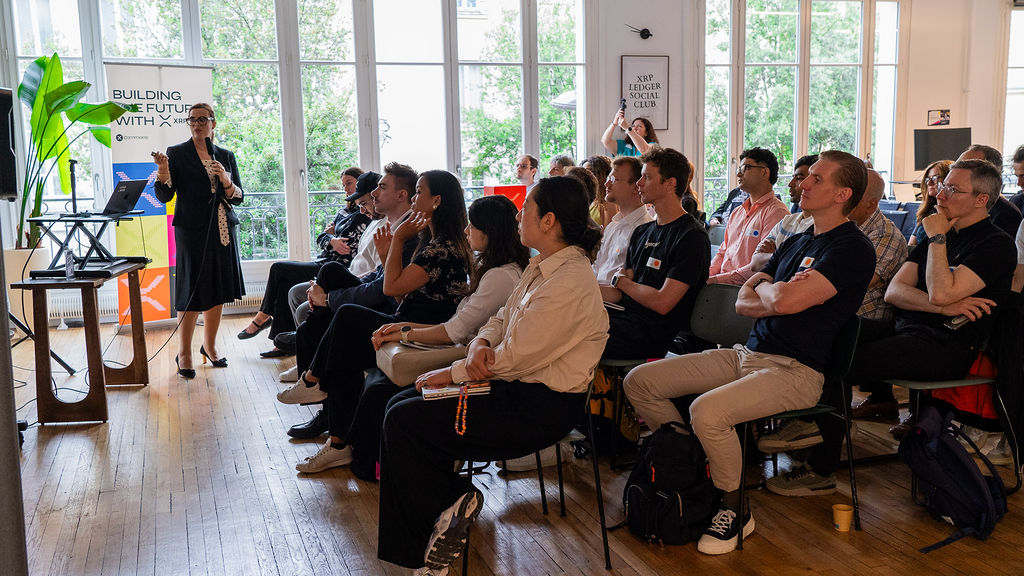
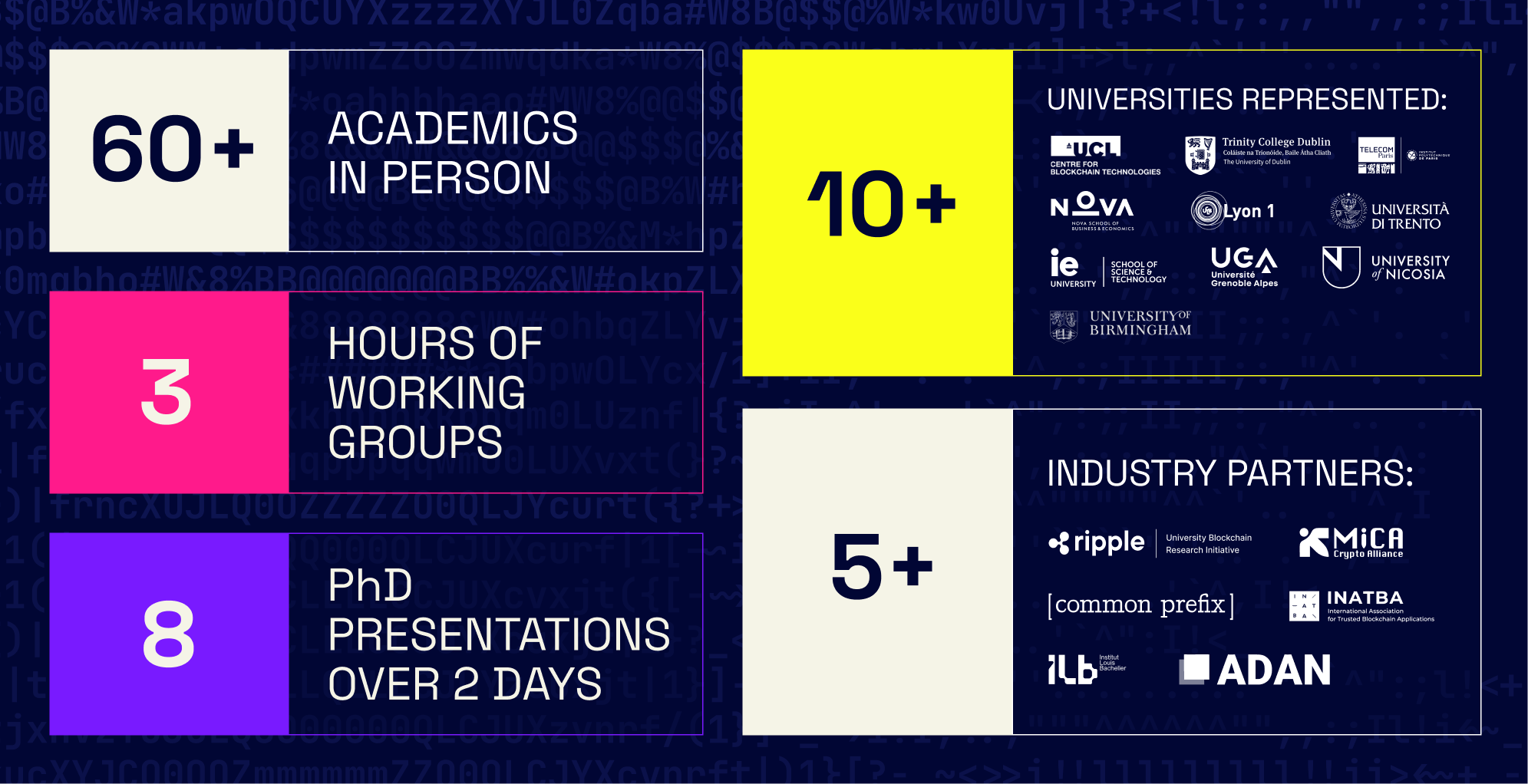
The Blockchain Research Summit, hosted by XRPL Commons and organized in partnership with the UBRI university network, convened over two days to ask — and begin answering — the questions that actually shape the next generation of decentralised infrastructure. Not what can be built on the XRP Ledger, but how: how do ZK proofs hold up under compliance constraints? How do PhD researchers translate whitepapers into deployable systems? How do regulators, builders, and educators find a shared language for what comes next?
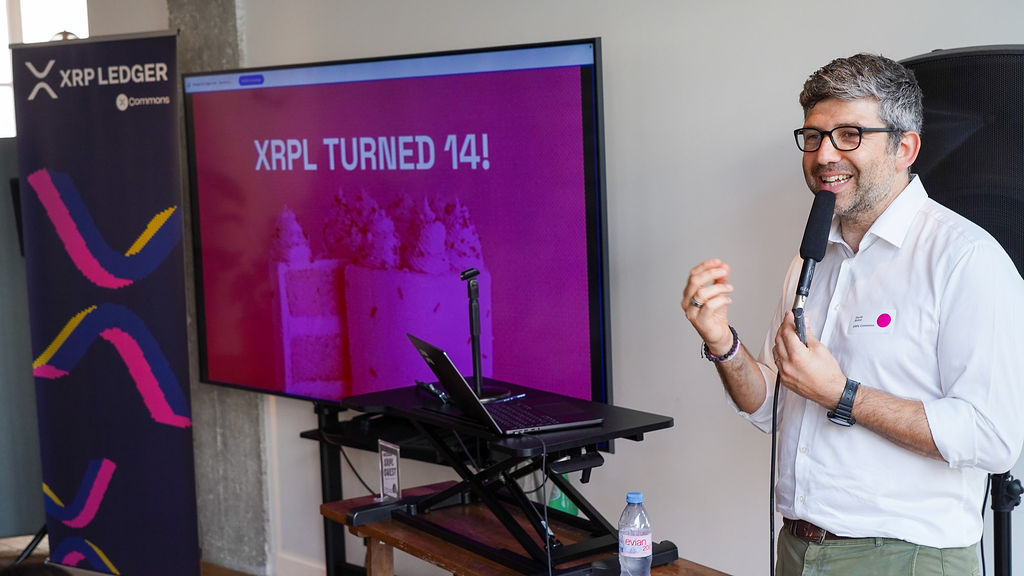
This edition marked both XRPL Commons' third anniversary and the XRPL's fourteenth, a milestone that reflected the maturity of the community it has built: serious, curious, and committed to shipping real work.
Here is what surfaced.
Keynote: Where Protocol Research Is Heading
Aanchal Malhotra, Head of Research at RippleX, opened the summit with a keynote that set the intellectual frame for everything that followed: tracing where protocol-level research is heading and what it means for the XRP Ledger's next phase of development.
Five Working Groups, One Shared Question
The summit opened with a morning sprint: five parallel working groups tackling the field's most pressing challenges from five distinct angles. Each group ran for three hours, producing outputs that fed directly into the afternoon's presentations. The format was deliberately collaborative. Participants mapped existing solutions, surfaced gaps, and identified the questions worth pursuing further. The working group sprint is one of the summit's defining features: it turns an audience into a research community.
Here is what each working group (WG) concluded.
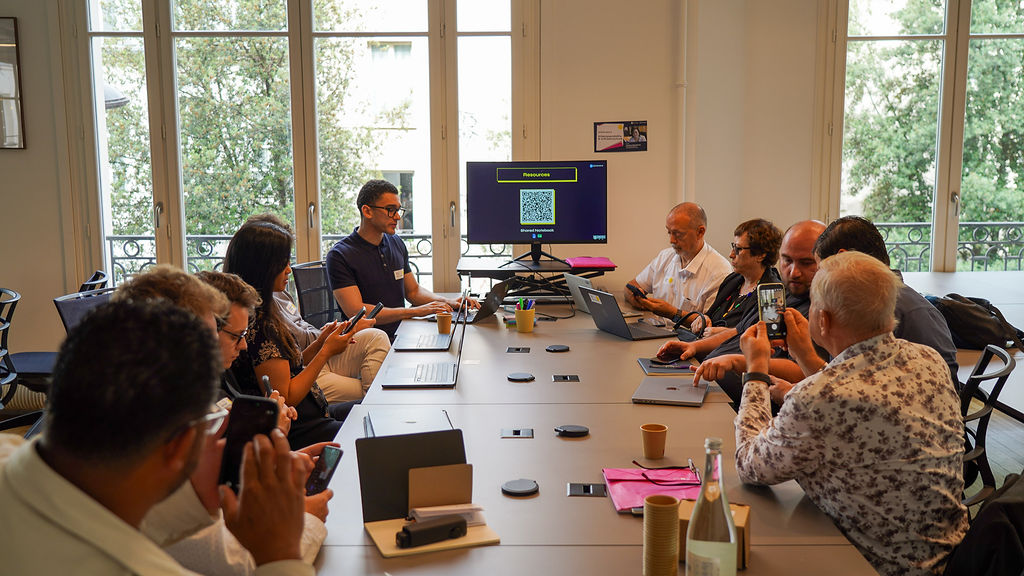
WG-A: Cryptography for Privacy & Identity, led by Prof. Federico Pintore, University of Trento
The group examined how verifiable computation, post-quantum cryptography, and zero-knowledge proofs can be integrated to strengthen security, privacy, and efficiency on the XRPL. The central tension it kept returning to: how to preserve regulatory transparency without eroding user confidentiality. These are not opposing demands. However, resolving them requires architectural choices that the field has not yet standardized.
WG-B: Interoperability & Infrastructure, led by Prof. Parisa Ghodous, University of Lyon 1
Cross-organizational blockchain collaboration remains blocked by the same structural problems it has faced for years: siloed data, inconsistent governance, and absent security standards that work across systems. The group's conclusion was explicit: standardised governance frameworks, interoperable data models, and shared security architecture are prerequisites, not nice-to-haves, for ecosystem-level adoption.
WG-C: Intelligent Web, led by Vito Tumas, PhD, Software Engineer , Ripple
This group explored one of the more technically charged questions of the summit: whether formal verification and large language models can be made to work together to secure critical software. The answer was cautiously affirmative. Formal methods offer a meaningful check on AI hallucinations in high-stakes environments, but human oversight remains essential for shaping specifications and managing edge cases. The combination is promising; the dependency on human judgment is irreducible.
WG-D: Compliance, led by Margaux Bassoli, University of Grenoble
The group concluded that the compliance-innovation tension is most productively resolved not through top-down regulatory mandates, but through industry-led, technology-driven self-regulatory models. The focus, practically, should be on institutional financial products, where the compliance demands are clearest and the tooling gap is most consequential. Closing that gap is what builds the ecosystem trust that broader adoption depends on.
WG-E: Digital Trust to Strengthen European Competitiveness, led by Jolanda ter Maten, INATBA
Europe's fragmented national digital policies are a competitive liability. The group argued for a shift toward unified digital infrastructure, one where blockchain and AI agents work in combination to automate compliance, protect privacy, and reinforce digital trust at scale. The ambition is European-level coherence; the starting point is the political will to treat digital infrastructure as a shared strategic asset.
From Whitepaper to Mainnet: Research That Ships
The afternoon's first session put live code on the screen. And kept it there.
Three projects demonstrated not just what they had built, but that it works.
- The Institut Louis Bachelier and XRPL Commons presented a data ingestion pipeline for XRP, developed by Thibaud Barreau and Mohamed Fahmaoui.
- ZKBallot, presented by Atharva Lele, Harsha Vardhan, and Hitesh Tewari, showed a complete ZK-proof architecture for anonymous voting, including a live end-to-end demo: cast a ballot, verify it, and confirm the result, all without revealing the voter.
- InvizCrypt followed with a demonstration of collaborative document editing under encryption: create, encrypt, and share a file live, without the platform ever seeing its contents.
New Voices, Real Stakes: PhD Research Meets Industry
The summit's PhD showcase sessions across both days reflected the breadth and ambition of the research pipeline feeding into the XRPL ecosystem.
Day one brought four presentations from emerging researchers:
- Margaux Bassoli (University of Grenoble) on blockchain, ownership, and the digital art market;
- Nikolaos Kamarinakis (Common Prefix) on building cross-chain applications between XRPL and XRPL EVM;
- Maxence Brugeres (Telecom Paris) on enforcing compliance in private payments using provenance graphs;
- Walter Hernandez (UCL) on AMM and CLOB optimisation for better DeFi routing on the XRP Ledger.
Day two continued the series with four more:
- Alice Kawai Ng (UCL) on simulation-based tokenomics frameworks for protocol incentive design;
- Félix Villemin (Common Prefix) on formal verification of the XRP Ledger;
- Florine Shifra Elskamp (Nova SBE) on Proof of Quantum Work;
- Atharva Lele (Trinity College) on making ZK proofs quantum-safe on the XRP Ledger.
Each presenter had ten minutes and five for Q&A. The format was disciplined, the material substantive.
EU Regulation in Practice: Perspectives from the Front Line
The day one regulatory panel brought together three practitioners working at the sharp edge of European crypto policy.
Eya Abid (Digital Asset Regulatory Specialist, Mica Crypto Alliance), Belen Suarez (Board Chair, INATBA), and William O'Rorke (Board Member and Secretary, ADAN) offered perspectives from the compliance desk, the industry association, and the legal practice — moderated by Perrine de Coetlogon (Open Education & Digital Identity Officer).
The conversation moved between MiCA's practical implications, the compliance tooling still missing from the ecosystem, and what regulated institutions actually need before they can deploy on-chain. The consensus was clear: the regulation is here; what follows now is implementation.
EU Research Grants & the Horizon 2026 Reality Check
Day two opened with a substantive session on the funding landscape for blockchain research in Europe.
Tonia Damvakeraki (Policy Researcher, University of Nicosia and EU Blockchain Observatory and Forum) mapped the EU Web3 funding landscape, where the money is, where it isn't, and what the application process actually requires. The panel that followed brought together Tonia Damvakeraki, Lina from Institut Louis Bachelier, and Jolanda ter Maten (Expert Evaluator for Horizon), moderated by Vera Radeva (Education Director, XRPL Commons).
The discussion was titled "From Application to Innovation: The Horizon 2026 Reality Check", and delivered exactly that. The gap between eligible research and fundable proposals, the evaluation criteria that catch researchers off guard, and the structural misalignment between academic timelines and EU project cycles were all put plainly on the table.
The keynote from Alexander Chevtaev (IE Madrid) followed, on bridging research to real-sector adoption through agentic payments in decentralised environments.
Can You Actually Teach Blockchain?
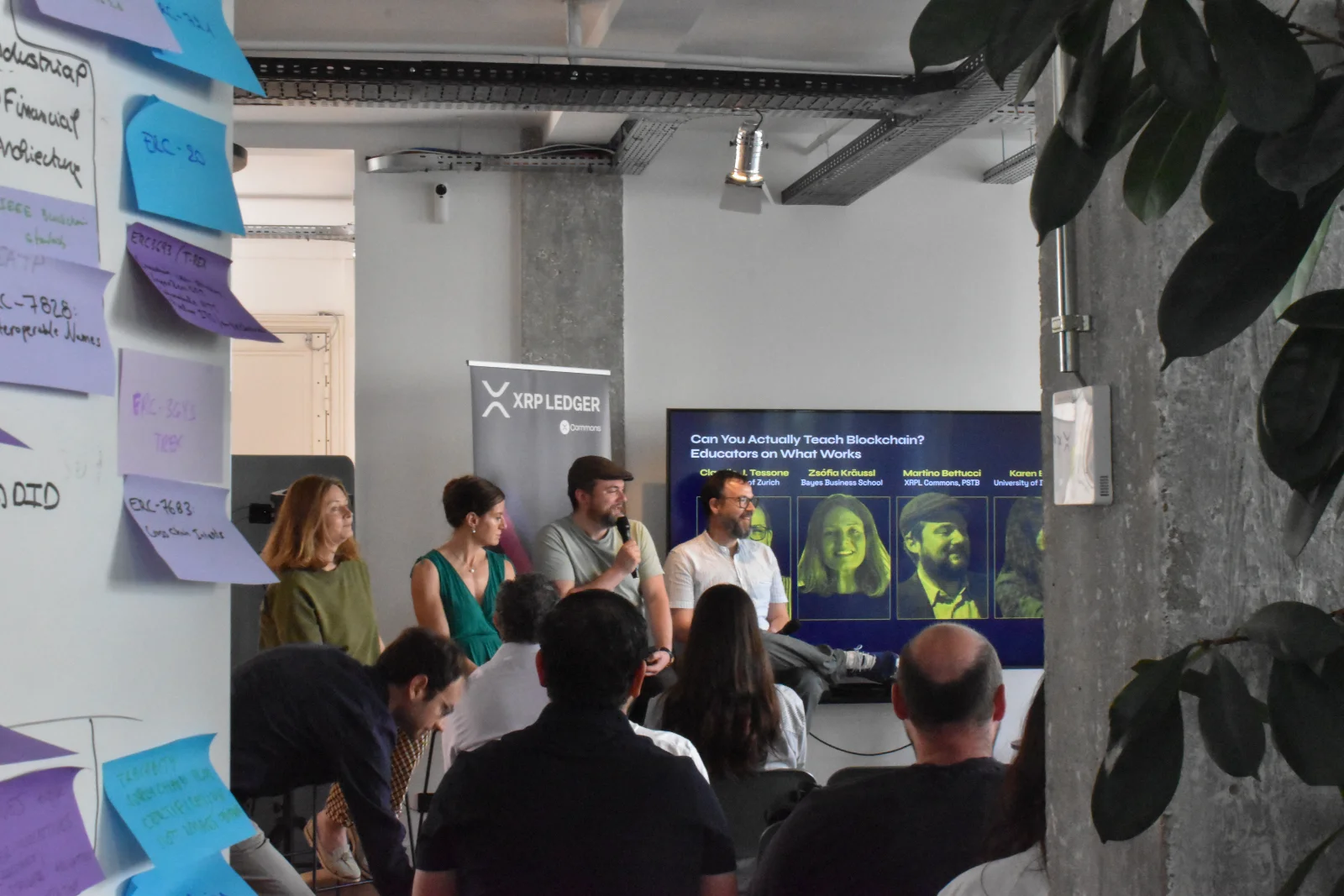
One of the summit's most anticipated sessions was also its most honest. A fireside chat brought together four educators from the XRPL Academic Pool — Prof. Zsofia Kraussl, Prof. Karen Elliott (University of Birmingham), Prof. Claudio Tessone, and Martino Bettucci — to answer a question that the field rarely asks directly: Can you actually teach blockchain?
The conversation covered curriculum design, the challenge of keeping technical content current, what students actually struggle with versus what educators assume they struggle with, and the persistent gap between what industry needs and what universities deliver. No consensus was reached on every point, which was, arguably, the point.
Shape What's Next: Open Curriculum Co-Design
The morning closed with something rare in academic conference programming: a session explicitly designed to produce outputs, not opinions.
The Open Curriculum Co-Design session invited participants to collectively define what a rigorous, current, and practically useful blockchain education programme looks like — across technical depth, regulatory literacy, and research skills. The session fed directly into XRPL Commons' ongoing work with the UBRI network of 60+ university partners, and its outputs will inform how programmes are designed and updated across institutions.
Key Outcomes of the session:
29 syllabus proposals with average course length: 9 weeks
What's Next?
Two days, ten working group hours, eight PhD presentations, three live demos, and one open curriculum session later, the summit produced something harder to quantify than a proceedings document: a shared sense of which problems are worth solving, and who in this community is already working on them.
XRPL Commons will be publishing session summaries, working group outputs, and follow-up materials in the weeks ahead. For researchers, educators, and builders interested in contributing to or connecting with the UBRI academic network, please reach out here: academy.xrpl-commons.org/syllabus
Let's build the research infrastructure the next generation of decentralised systems deserves.



.jpg)


