


Stablecoins, Regulation, and the New Credit Rail
Over the past few years, digital finance has undergone a shift that is difficult to overstate. The surge in stablecoin adoption, tokenized assets, and on-chain financial activity has moved from the edges of capital markets toward their center - attracting institutions, financial and tech players, regulators, and policymakers who had previously watched from a distance.
Regulatory frameworks are now advancing in step. The EU's MiCA regime, the GENIUS Act in the United States, and a growing body of frameworks across Asia, the Middle East, and Africa are establishing credible, consistent standards for reserve quality, governance and compliance. This clarity matters; it gives players a more reliable basis on which to evaluate, adopt, and scale on-chain financial activities.
The result is that many of the world's leading financial institutions, asset managers, payment providers, and fintechs are now actively looking to harness the innovation, operational efficiency, and programmability that digital finance enables - not as an experiment, but as a strategic priority.
Yet putting assets on-chain is only half the work. Tokenizing a Treasury bill, or holding a regulated stablecoin, makes an asset programmable. It does not, on its own, make it productive. Capital markets run on what comes next: borrowing against an asset, posting it as collateral, raising liquidity without selling. That layer is credit, and it's coming on-chain.
XRPL's Institutional DeFi Roadmap
The XRP Ledger was designed for this moment before the moment had a name. Since 2012 it has settled financial transactions at scale, with deterministic finality, sub-cent fees, and a consensus model that carries no miners, no gas auctions, and no MEV. It was built as financial-market infrastructure, and every capability added since has extended that single premise.
Its architecture reflects a deliberate focus: rather than serving as a general-purpose deployment platform, XRPL has concentrated on building protocol-native primitives for financial services and extending them through amendments to a single ledger, preserving continuity of liquidity and governance as capabilities grow.
XRPL's institutional DeFi journey is a progressive and deliberate layering of financial capabilities on a stable, proven settlement foundation. This is supported by a working market structure: a protocol-native Decentralized Exchange (DEX) and Automated Market Maker (AMM), Multi-Purpose Tokens (MPTs) as a lightweight RWA standard, and a compliance and identity layer built from Credentials, Deep Freeze, Permissioned Domains, and a Permissioned DEX that brings Credential-based access to liquidity, based on offchain compliance logic such as KYC, AML, and sanctions screening into the protocol itself. Each of these shipped as an on-ledger amendment, so every new capability plugs into the same liquidity and the same governance. That is the quiet advantage: the XRP Ledger has grown without fragmenting, and the focus shows in the data. XRPL is now positioned among the top three chains for RWA tokenization, with multiple regulated stablecoin projects live on the ledger.
Introducing XRPL Credit On-Chain
And now, at precisely the moment institutional DeFi is maturing from concept into production, XRPL is introducing one of its most consequential primitives yet. The Single Asset Vault (XLS-65) and the Lending Protocol (XLS-66) amendments bring native, underwritten credit and yield generation directly into the ledger.
This is a progressive and deliberate layering of financial capabilities on a stable, proven settlement foundation- not a pivot, but a planned evolution of a ledger that has been handling institutional transactions reliably for more than a decade.
With on-chain credit markets growing in total value and a new generation of regulated participants seeking capital productivity from their digital assets, this is not a DeFi application built on top of XRPL. It is credit as protocol infrastructure, embedded at the consensus layer- the missing piece that transforms a settlement network into a full 24/7 digital finance, capital markets platform.
What the Protocol Actually Is
The XRPL Lending Protocol is defined in the XLS-65 and XLS-66 (currently in voting) specifications and implemented as native ledger objects rather than smart contracts. The distinction carries real weight. Smart-contract lending systems bring ongoing audit burden, composability risk, and governance that can rewrite the rules mid-life. Protocol-level lending inherits the security and throughput of the ledger, with more than a decade of production behind it.
XLS-65 defines the Single Asset Vault: an on-ledger, pooled container for one XRPL-based asset, whether XRP, RLUSD, a bank-issued stablecoin, or an MPT-based RWA. Vaults aggregate deposits, issue LP tokens that track pro-rata ownership, and hold transparent balances. They can run open and permissionless, or gated and permissioned. The vault separates where capital sits from how lending logic runs, which is what lets one vault serve many products instead of being rebuilt for each.
XLS-66 (currently in voting) adds the credit layer: LoanBroker registration, on-chain loan objects that carry principal, tenor, interest, and amortization schedule, configurable fees, optional first-loss capital, grace periods, and default handling that adjusts LP-token value in proportion. Repayments resolve on second-based schedules, with early repayment and overpayment allowed under configurable policy.
What the protocol deliberately leaves alone is institutional judgment. Underwriting and collateral management stay off-chain, with the teams that already hold the policies, the regulatory obligations, and the accountability for a credit decision. XLS-66 standardizes what happens after that decision: how capital is drawn, how interest accrues, how repayments are scheduled, how a default is recorded. The full lifecycle runs several defined stages: pool creation; capital deposit and LP issuance; off-chain collateral management linked on-chain by metadata; loan origination and drawdown; automated repayment with interest and fee allocation; default handling through first-loss liquidation; and pool closure with LP redemption. Every stage is auditable, and enforceable without deploying a line of contract code.
The XRPL Lending Protocol's central design principle is a clean separation of responsibilities: institutions retain full control over credit decisions - underwriting, documentation, collateral management, and regulatory compliance - while the protocol standardizes execution once terms have been agreed. This is the inverse of how most on-chain lending systems have been built, and it is where XRPL's institutional differentiation is clearest.
XRPL Lending Protocol Value Proposition
This architecture and design introduce new strategic value propositions where core assets generate native yield within underwritten facilities rather than sitting idle. Market makers, payment providers, and treasuries can finance inventories and bridge settlement gaps using programmable on-chain facilities that integrate with existing back-office processes.
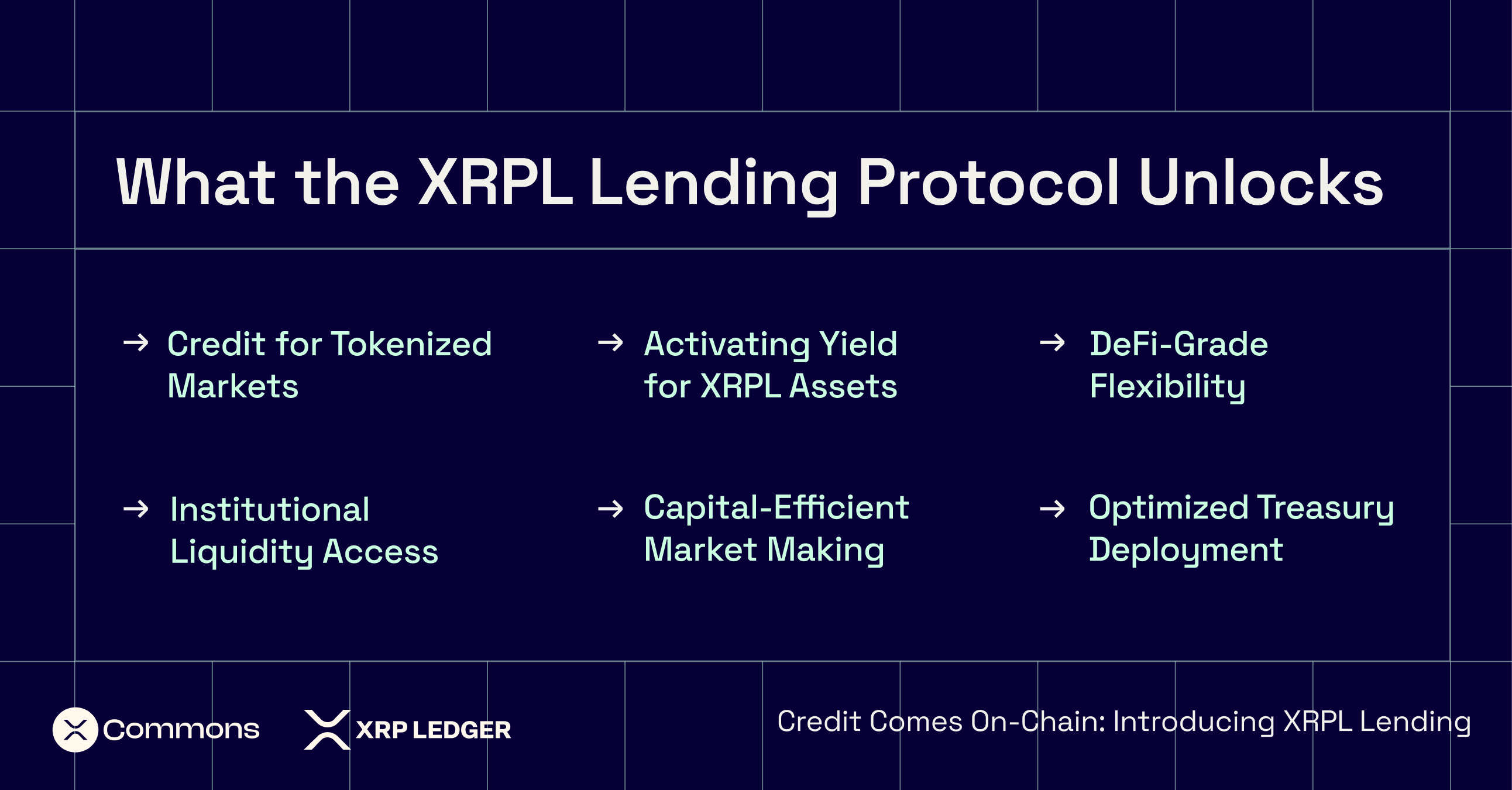
Unlocking the missing credit layer for tokenized markets: Transforms on-chain assets into usable collateral and real liquidity. Bringing assets on-chain is only the first step; this protocol focuses on what real markets actually need next- borrowing against those assets, using them as collateral, and accessing liquidity while retaining ownership.
Yield Generation: Turns XRP and other XRPL-based assets from non-yielding assets into productive ones: users earn protocol-based interest for providing capital.
DeFi-Grade Flexibility: Models the sophistication of the leading DeFi platforms designed explicitly for XRPL’s low costs and instant finality.
Institutional Liquidity Access: Enables payment providers to draw short-duration liquidity to bridge settlement timing gaps without disrupting core settlement flows.
Capital-Efficient Market Making: Allows market makers to finance inventory without selling core assets, improving balance sheet efficiency while maintaining continuous market presence.
Treasury Deployment: Gives treasury teams a way to deploy idle digital assets into underwritten facilities with clearer terms, risk allocation, and on-chain transparency.
Structured Credit Enablement: Enables lenders to build structured credit products on top of a common infrastructure layer, instead of engineering bespoke protocols for each transaction.
Offering and Use Case per Player
The protocol meets the different stakeholders in their unique position across the value chain:
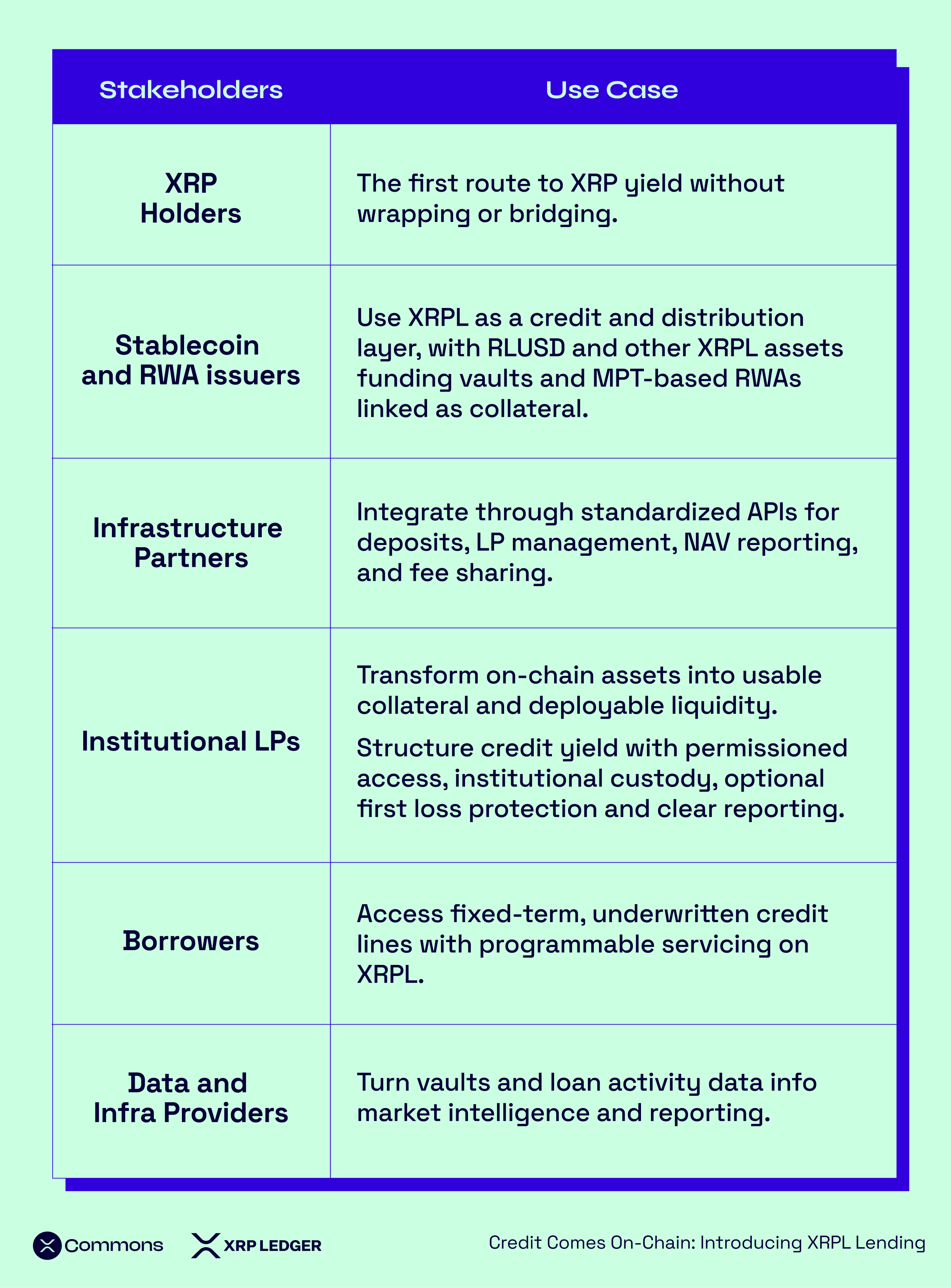
XRP holders- gain native, underwritten yield through curated Single Asset Vaults inside exchanges, wallets, and institutional platforms, the first route to XRP yield without wrapping or bridging.
Stablecoin and RWA issuers- use XRPL as a credit and distribution layer, with RLUSD and other XRPL assets funding vaults and MPT-based RWAs linked as collateral, while permissioned controls manage illicit-use risk.
Infrastructure partners- Exchanges, wallets, and DeFi platforms integrate through standardized APIs for deposits, LP management, NAV reporting, and fee sharing, with time-to-market in weeks rather than months.
Institutional LPs- Asset managers, treasury desks, and family offices allocate into permissioned vaults with KYC-gated access, established custody, first-loss protection, and clear reporting. Prime brokers, market makers, Ffintech lenders, and corporates draw fixed-term, underwritten credit with programmable servicing, while their collateral, documentation, and compliance stay inside existing frameworks.
Borrowers- prime brokers, market makers, fintech lenders, corporates- access fixed-term, underwritten credit lines with programmable servicing on XRPL, while collateral, documentation, and compliance remain within their existing institutional frameworks.
Data and infrastructure providers- build analytics, NAV, utilization, and default-rate dashboards on vault and loan events- supporting both commercial reporting and regulatory oversight.
Getting Started
The conditions defining the next phase of institutional digital finance are already assembled. The missing layer- credit, yield, and capital productivity for the assets that now live on these networks- is what the XRPL Lending Protocol provides. The decisions made now will shape the architecture of on-chain capital markets for years to come.
XRPL Commons works with the different players across the value chain: educating, identifying the relevant use case, mapping roles across the lending architecture, designing structures and operating models, defining integration paths and identifying partners. Those who move first will define the standards the market adopts. The infrastructure is here. The next decision is who builds on it.
We are here to support your journey. Contact: adoption@xrpl-commons.org
The XRPL Lending Protocol (XLS-65, XLS-66) is subject to validator approval. To explore integration, contact XRPL Commons.



.jpg)


